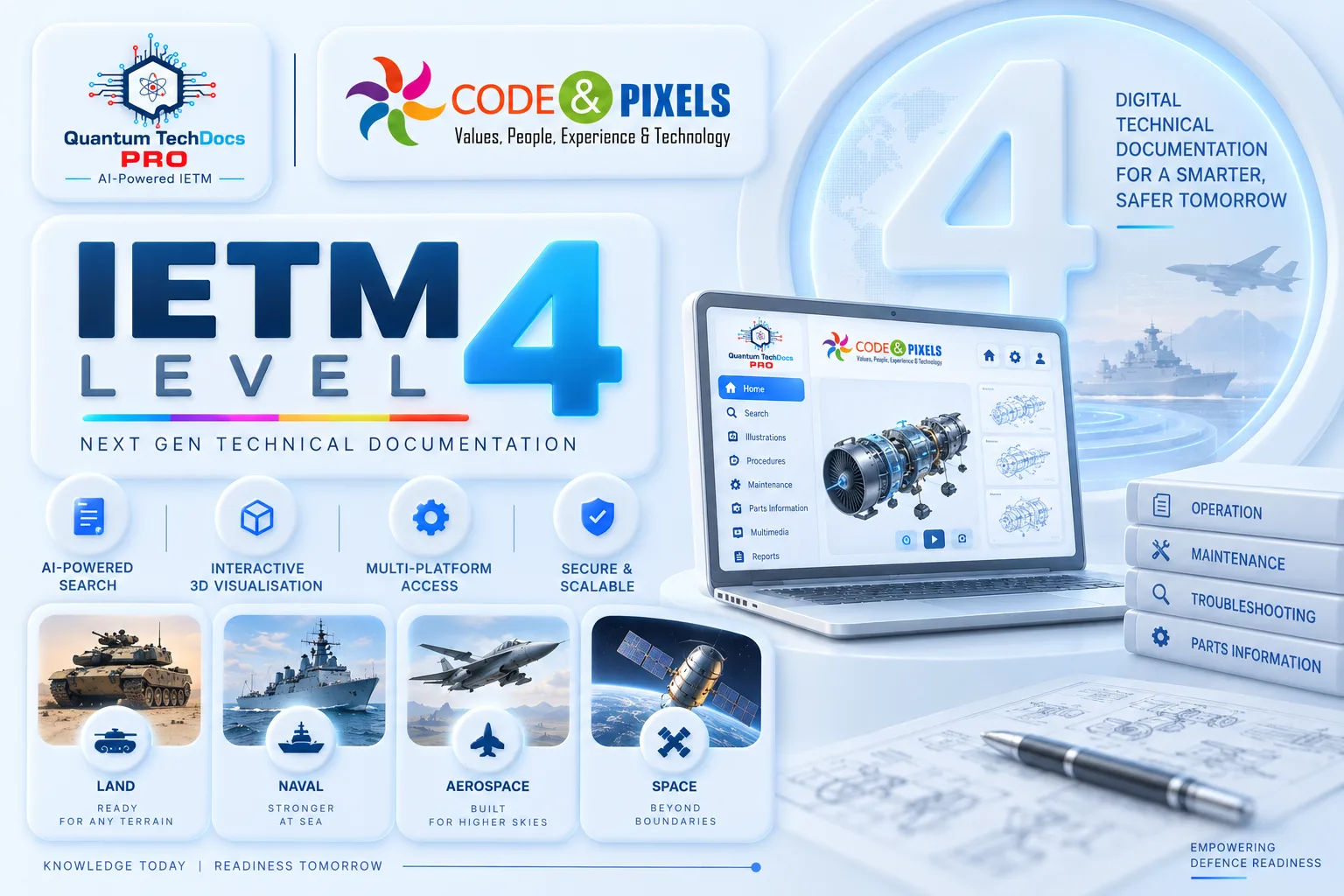
IETM Level 4 is an advanced form of Interactive Electronic Technical Manual designed to provide structured, searchable, and interactive access to large volumes of technical information.
Unlike basic electronic manuals, Level 4 uses a database-driven architecture to organise technical content and provide powerful search, navigation, cross-referencing, user management, annotations, activity tracking, and multimedia capabilities.
IETM Level 4 is particularly suitable for defence, aerospace, naval, military, engineering, and other complex technical systems where users need fast access to extensive technical documentation.
IETM Level 4 is a hierarchically structured IETM in which technical information is organised within a database-oriented environment.
JSG 0852:2025 identifies Class IV as “Hierarchically Structured IETM”, with structured data, database-based management, interactive navigation, and technical information presented through an electronic interface.
A Level 4 environment can bring together:
The basic architecture can be understood as:
Technical Documentation → Structured Content → IETM Database → IETM Viewer → User
The technical information is structured and stored within the database. The IETM Viewer provides users with an interactive interface for accessing the information.
An IETM Level 4 solution can also include an Authoring Module for creating and managing content and an Administrator Module for managing users and system activities.
The Viewer is the user-facing application used to access published technical information. It can provide:
The Authoring System is used to create and manage structured IETM content. It can support:
The Administrator environment manages users, access, activities, and other system functions. Typical capabilities include:
A database-driven IETM can provide powerful search capabilities across structured technical information. Users can search for:
Technical content can be organised into a structured hierarchy such as:
System → Subsystem → Component → Procedure → Technical Information
This makes large documentation collections easier to navigate.
Technical information can be interconnected through related-topic references.
A user viewing one procedure can access associated technical information without manually searching for another document.
Hyperlinks connect related technical content, allowing users to move between procedures, drawings, components, tables, and other information.
Hotspots can be applied to text, images, drawings, and other supported content.
Selecting a hotspot can take the user directly to associated technical information.
The system can record user activity such as login and logout information, document access, and search activity, depending on the implementation.
Users can bookmark frequently accessed technical information for easier future access.
Users can add notes or comments to technical content where enabled by the system configuration.
Administrators can manage user accounts and assign appropriate roles and access rights.
A glossary can provide definitions, abbreviations, and technical terminology associated with the IETM content.
Technical drawings are an important part of many IETM applications. A Level 4 system can provide access to drawings and connect graphical elements with related technical information.
Interactive drawings can use hotspots to connect:
Component → Part Information → Procedure → Related Technical Content
This can make component identification and technical navigation more efficient.
IETM Level 4 can act as a centralised environment for different types of technical media. Depending on project requirements, content can include:
Multimedia provides additional ways to explain complex equipment and maintenance procedures.
3D is an additional capability that can be integrated into an IETM. It does not by itself define IETM Level 4. 3D technical content can provide:
JSG 0852:2025 discusses 3D technologies, interactive BOMs, exploded views, annotations, rotation, zoom, pan, and synchronised 3D animations as developments in technical documentation.
Level 4 is well suited to maintenance-oriented technical information because procedures, components, drawings, and related references can be connected within the IETM environment.
A maintenance workflow can include:
Equipment → Fault → Troubleshooting → Component → Removal → Repair/Replacement → Installation → Testing
Users can navigate between these information elements using search, hyperlinks, related topics, and interactive references.
IETM Level 4 can be used for complex defence technical documentation involving:
The applicable IETM class and project requirements should always be determined according to the relevant customer specification and applicable standard.
JSG 0852:2025 defines Class IV as Hierarchically Structured IETM and describes its database-oriented characteristics.
The guide also describes Class III as the class specified for use in Defence Services, so IETM Level 4 should not be presented as universally mandated for every Indian defence project. The applicable class depends on the project specification and requirements.
| IETM Level 3 | IETM Level 4 |
|---|---|
| Structured electronic information | Advanced database-driven information |
| Linear structure | Hierarchical structure |
| Search capabilities | More powerful database search |
| Hyperlinks | Hyperlinks and advanced cross-references |
| Interactive navigation | Advanced navigation |
| Multimedia support | Multimedia and database integration |
| Structured content | Structured database content |
| Basic user functions | User management and activity features |
| Suitable for structured manuals | Suitable for larger, complex info environments |
Defence technical information may require controlled access. An IETM Level 4 system can incorporate security mechanisms such as:
IETM Level 4 can be deployed in controlled or offline environments where continuous internet access is not appropriate or available. Useful for:
The database-oriented structure makes it suitable for technical environments containing large amounts of interconnected information. It brings together:
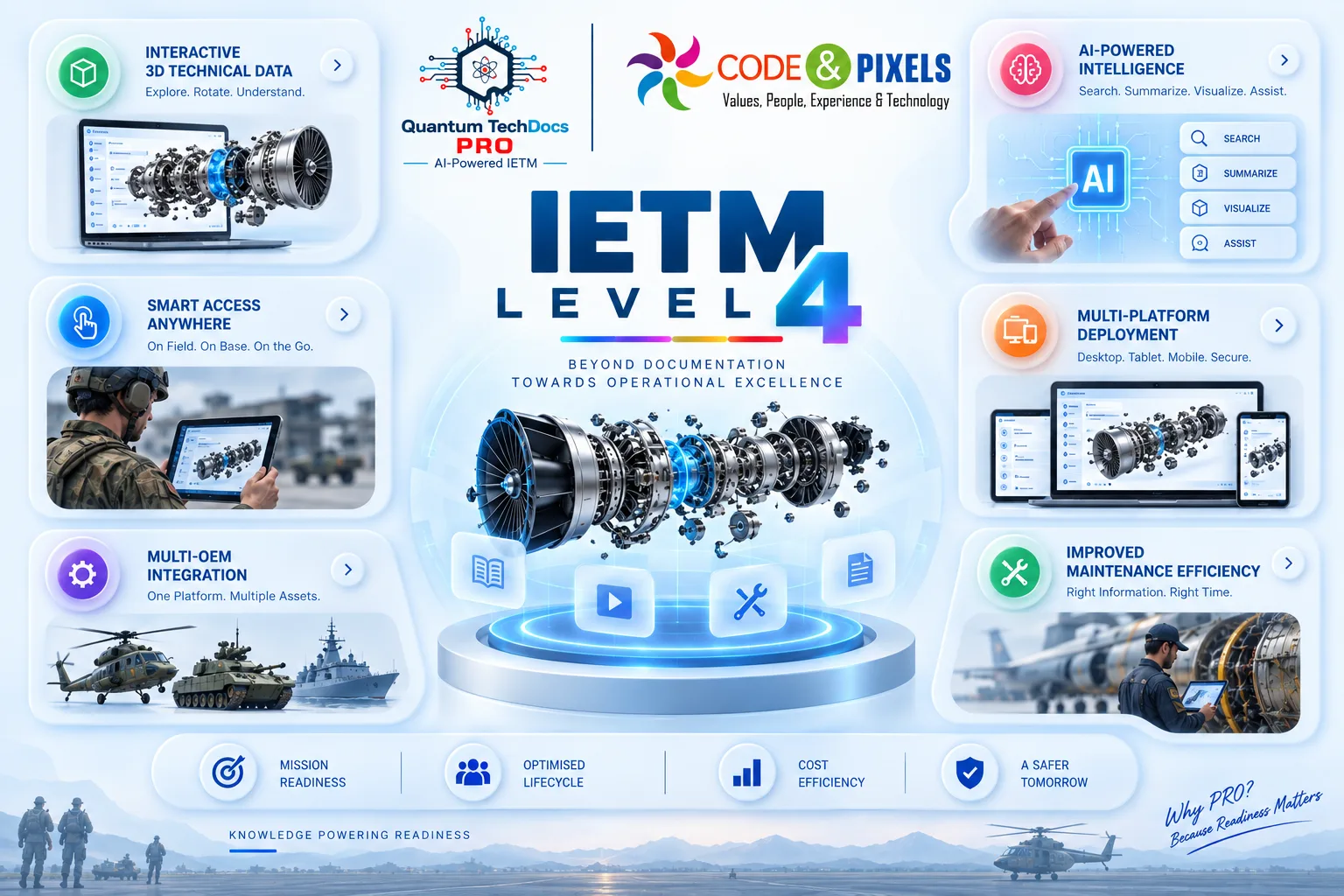
IETM Level 4 can be extended with Artificial Intelligence to create an AI-powered IETM. AI adds:
Database-Driven IETM → AI-Enhanced IETM → Intelligent Technical Knowledge Environment
AI enhances information retrieval but does not replace the underlying technical documentation structure or applicable project requirements.
Defence OEMs can use Level 4 IETM environments to organise technical information throughout the equipment lifecycle. Applications can include:
IETM Level 4 is an advanced, hierarchically structured IETM that uses a database-oriented approach to manage and provide interactive access to technical information.
No. IETM Level 4 is an interactive technical information system, not simply a PDF file.
Yes. Database-oriented technical information management is a defining characteristic of the advanced Level 4 approach.
Key features can include advanced search, hierarchical navigation, hyperlinks, hotspots, related topics, bookmarks, annotations, glossary, user management, activity tracking, drawings, multimedia, and database-driven information.
Yes. 3D models, exploded views, animations, interactive BOMs, and other 3D content can be integrated where required.
Yes. AI can be added to provide natural-language queries, intelligent search, knowledge retrieval, and AI-assisted information access.
Yes. It can be designed for offline or controlled-network deployment when required by the project.