An Interactive Electronic Technical Manual (IETM) is a structured digital technical information system designed to make manuals easier to access, search, navigate, and maintain.
IETMs transform conventional technical documentation into an interactive electronic environment where users can access operating instructions, maintenance procedures, troubleshooting information, drawings, parts information, illustrations, videos, and related technical content from a unified system.
IETMs are widely relevant to defence, aerospace, naval, engineering, automotive, electronics, and other complex technical systems where large volumes of technical documentation need to be accessed efficiently.
IETM stands for Interactive Electronic Technical Manual.
Unlike a conventional PDF or printed manual, an advanced IETM provides structured technical information through an electronic interface with features such as search, hyperlinks, cross-references, navigation, bookmarks, annotations, multimedia, and related-topic access.
For complex equipment containing hundreds or thousands of technical documents, an IETM provides a centralised environment for accessing and managing technical information.
Complex systems generate large amounts of technical documentation covering operation, maintenance, servicing, troubleshooting, components, safety procedures, and technical specifications.
Searching through multiple printed manuals or independent PDF files can make information retrieval difficult. An IETM helps users:
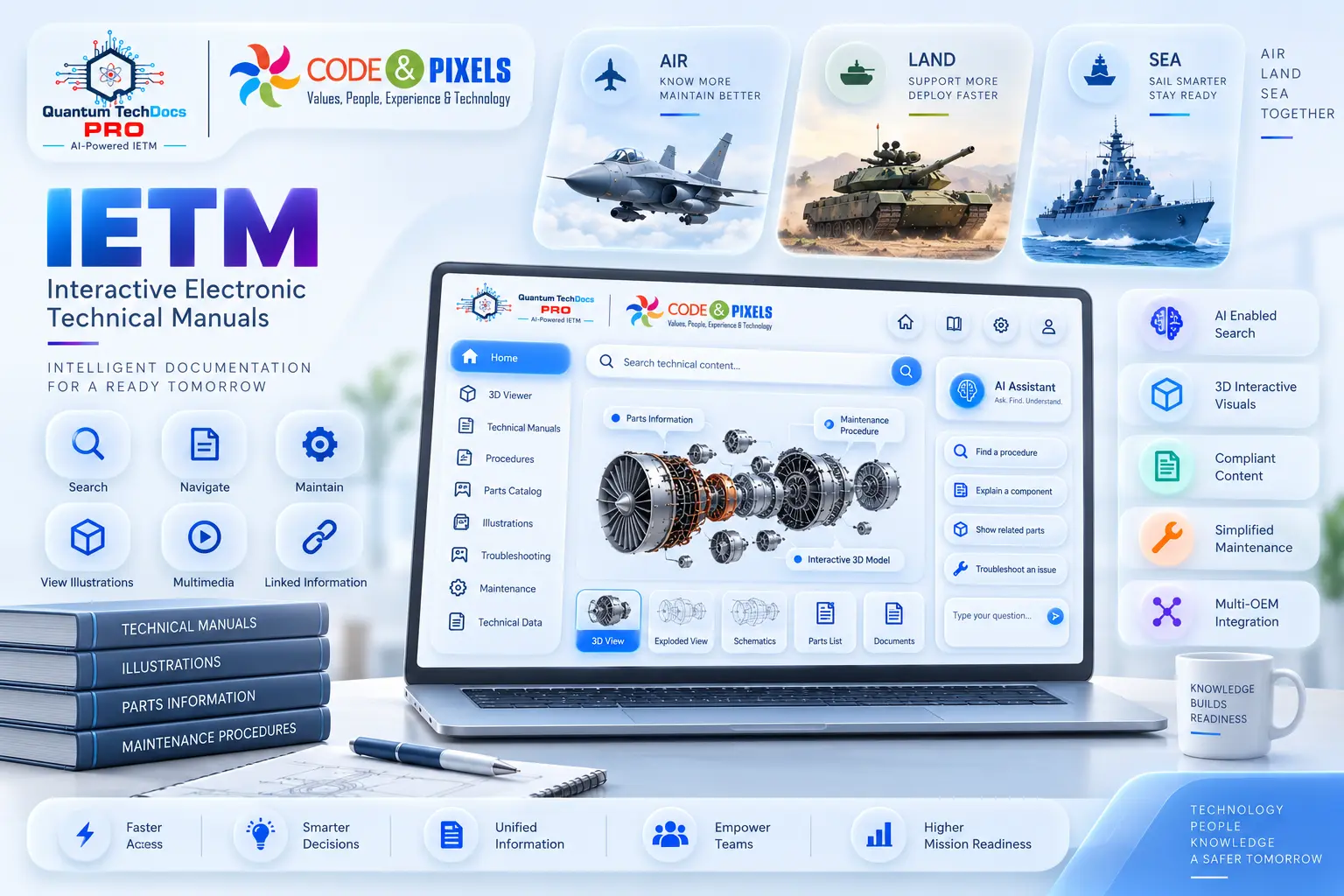
IETMs are particularly valuable for defence systems because equipment often consists of multiple interconnected systems and subsystems with extensive technical documentation.
Typical applications include:
An IETM provides users with a structured environment to access the technical information required for operation, maintenance, servicing, and troubleshooting.
An IETM generally combines structured technical content, a database, and IETM software.
Technical manuals and supporting information are converted into a structured format and organised according to the required content hierarchy. The IETM environment can then provide:
The viewer is the user-facing application through which technical personnel access the published IETM. It can provide:
The authoring environment is used to develop and publish the IETM. It can support:
The administration environment can be used to manage users and monitor system activity. Typical functions include:
IETMs can be classified into different levels based on their degree of structure, interactivity, and functionality.
Scanned pages or simple PDF-based electronic documentation.
PDF-based technical documentation with links and basic navigation.
HTML/XML-based technical information with structured navigation.
A database-driven IETM providing structured technical information, advanced search, navigation, hyperlinks, multimedia and user-management capabilities.
Advanced integration involving real-time equipment or operational data. According to the Code & Pixels reference material, Level 5 is not practically in use as of the stated date and requires real-time data integration.
For Indian defence applications, JSG 0852 provides requirements and guidance for IETM development and implementation.
The JSG 0852:2025 Third Revision covers areas including general IETM features, IETM classes, defence-service requirements, database specifications, quality assurance, authoring/browser requirements, and version management.
IETM implementations for defence projects should therefore be developed according to the applicable project specification and required standard.
A modern IETM can include a wide range of Quantum TechDocs PRO features:
IETM can make technical illustrations more useful by connecting drawings with related technical information.
For example, selecting a component number in an illustration can take the user to its corresponding technical description, parts information, or maintenance procedure.
Hotspots can also be used to connect specific areas of an image with additional technical information.
IETM can integrate multimedia content to improve the presentation of complex technical information. Depending on the project, this may include:
3D and multimedia are additional capabilities integrated into an IETM, rather than defining what makes an IETM an IETM.
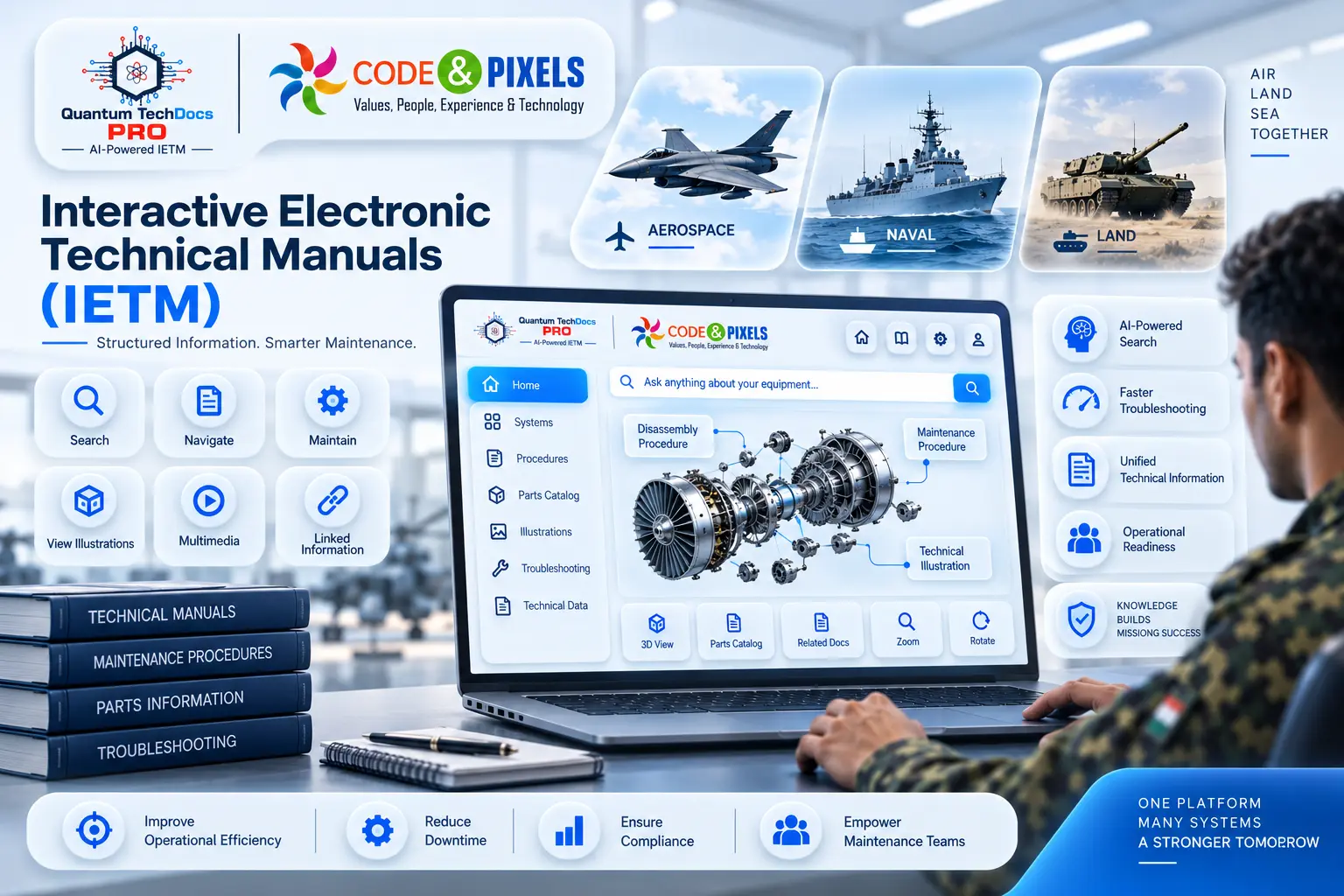
Search and structured navigation make technical information easier to locate.
Multiple manuals and supporting technical resources can be organised within one environment.
Maintenance personnel can access relevant procedures, drawings, troubleshooting information, and related topics from a common interface.
Hyperlinks, cross-references, related topics, and structured content reduce unnecessary manual searching.
IETM provides a structured approach to storing, publishing, updating, and accessing technical documentation.
Images, videos, animations, drawings, and 3D content can enhance technical understanding.
Maintenance personnel often need to find specific information quickly. An IETM can bring together:
This can reduce the effort required to locate information across multiple technical manuals.
Defence OEMs managing complex equipment require technical documentation that can support the complete operational and maintenance environment.
An IETM can consolidate technical information associated with equipment, systems, subsystems, components, maintenance procedures, drawings, troubleshooting, and supporting multimedia.
This makes IETM particularly suitable for organisations developing and supporting complex defence platforms.
Quantum TechDocs PRO is an IETM publishing platform designed for complex technical documentation environments.
The platform supports capabilities associated with modern IETM implementation, including structured technical information, search, multimedia, 2D and 3D integration, administration, and interactive technical content.
The evolution toward Quantum TechDocs PRO extends this environment with AI-powered capabilities for intelligent technical information retrieval.
IETM environments can be extended with Artificial Intelligence to provide more intelligent technical information retrieval. AI can be added to an IETM environment to provide capabilities such as:
This combination creates an AI-IETM, where Artificial Intelligence enhances how users interact with structured technical information.
IETM stands for Interactive Electronic Technical Manual.
An IETM is used to provide structured, searchable, and interactive access to technical documentation for equipment, systems, maintenance, operation, troubleshooting, and support.
No. An advanced IETM is an interactive technical information system rather than simply a PDF document.
IETM Level 4 is an advanced database-driven IETM that provides capabilities such as powerful search, structured navigation, hyperlinks, related topics, bookmarks, annotations, user management, and activity tracking.
JSG 0852 is an Indian Joint Services Guide associated with Interactive Electronic Technical Manuals and defence technical documentation requirements. JSG 0852:2025 is the third revision.
Yes. 3D models, exploded views, animations, drawings, images, and videos can be integrated into an IETM where required by the project.
Yes. AI capabilities can be integrated to improve technical search, natural-language queries, knowledge retrieval, and information access.
IETMs are particularly useful for defence organisations, OEMs, shipyards, aerospace companies, engineering organisations, maintenance teams, and other industries managing complex technical systems.